




Nonfiction
eAudiobook
Details
PUBLISHED
Made available through hoopla
EDITION
DESCRIPTION
1 online resource (1 audio file (7hr., 46 min.)) : digital
ISBN/ISSN
LANGUAGE
NOTES
Read by Eric Jason Martin
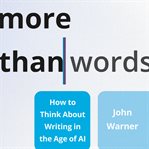
A veteran writing teacher makes a strong argument that writing is a form of thinking and feeling and shows why it can't be replaced by AI In the age of artificial intelligence, drafting an essay is as simple as typing a prompt and pressing enter. What does this mean for the art of writing? According to longtime writing teacher John Warner: not very much. More Than Words argues that generative AI programs like ChatGPT not only can kill the student essay but should, since these assignments don't challenge students to do the real work of writing. To Warner, writing is thinking-discovering your ideas while trying to capture them on a page-and feeling-grappling with what it fundamentally means to be human. The fact that we ask students to complete so many assignments that a machine could do is a sign that something has gone very wrong with writing instruction. More Than Words calls for us to use AI as an opportunity to reckon with how we work with words-and how all of us should rethink our relationship with writing. Dedication and Introduction Introduction - Not a Threat, an Opportunity Introduction - Alienation Nation Introduction - I Am, Therefore I Write Chapter 1 - Automation, Not Intelligence (1) Chapter 1 - Automation, Not Intelligence (2) Chapter 2 - Stop, Now, Before It's Too Late! (1) Chapter 2 - Stop, Now, Before It's Too Late! (2) Chapter 2 - Stop, Now, Before It's Too Late! (3) Chapter 2 - Stop, Now, Before It's Too Late! (4) Chapter 2 - Stop, Now, Before It's Too Late! (5) Chapter 2 - Stop, Now, Before It's Too Late! (6) Chapter 3 - A Personal History of the Automation of Writing (1) Chapter 3 - A Personal History of the Automation of Writing (2) Chapter 4 - Only Humans Write Chapter 5 - Writing Is Thinking Chapter 6 - Writing Is Feeling Chapter 7 - Writing Is a Practice (1) Chapter 7 - Writing Is a Practice (2) Chapter 7 - Writing Is a Practice (3) Chapter 7 - Writing Is a Practice (4) Chapter 7 - Writing Is a Practice (5) Chapter 7 - Writing Is a Practice (6) Chapter 8 - Life with a Writing Practice Chapter 9 - Reading and Writing Chapter 10 - Reading, Writing, and Robots Chapter 11 - Here Come the Teaching Machines (Again) Chapter 12 - Writing in the Classroom of Today (and Tomorrow) (1) Chapter 12 - Writing in the Classroom of Today (and Tomorrow) (2) Chapter 12 - Writing in the Classroom of Today (and Tomorrow) (3) Chapter 12 - Writing in the Classroom of Today (and Tomorrow) (4) Chapter 12 - Writing in the Classroom of Today (and Tomorrow) (5) Chapter 13 - Reading Like a Writer Chapter 14 - Content vs. Writing (1) Chapter 14 - Content vs. Writing (2) Chapter 14 - Content vs. Writing (3) Chapter 14 - Content vs. Writing (4) Chapter 14 - Content vs. Writing (5) Chapter 15 - On the Future of Writing for Money Chapter 16 - My Digital Doppelgänger Chapter 17 - A Framework for Action: Resist, Renew, Explore (1) Chapter 17 - A Framework for Action: Resist, Renew, Explore (2) Chapter 17 - A Framework for Action: Resist, Renew, Explore (3) Chapter 17 - A Framework for Action: Resist, Renew, Explore (4) Chapter 18 - Resist (1) Chapter 18 - Resist (2) Chapter 18 - Resist (3) Chapter 18 - Resist (4) Chapter 18 - Resist (5) Chapter 18 - Resist (6) Chapter 19 - Renew (1) Chapter 19 - Renew (2) Chapter 19 - Renew (3) Chapter 19 - Renew (4) Chapter 19 - Renew (5) Chapter 19 - Renew (6) Chapter 20 - Explore (1) Chapter 20 - Explore (2) Chapter 20 - Explore (3) Conclusion and Acknowledgments "Eric Jason Martin narrates this timely treatise on writing and AI…His slow pacing and crisp enunciation give the listener every opportunity to mull this well-reasoned argument. Final chapters offer suggestions for when, why, and how to push back against the AI onslaught." "Illustrate[s] that the act of writing is not about the production of words but is, rather, a complicated and deeply human process that involves a relationship between thought, mem
Mode of access: World Wide Web