




Nonfiction
eBook
Details
PUBLISHED
Made available through hoopla
DESCRIPTION
1 online resource
ISBN/ISSN
LANGUAGE
NOTES
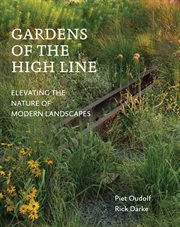
"If you can't get to the High Line. . . this is the next best thing." -The Washington Post Before it was restored, the High Line was an untouched, abandoned landscape overgrown with wildflowers. Today it's a central plaza, a cultural center, a walkway, and a green retreat in a bustling city that is free for all to enjoy. This beautiful, dynamic garden was designed by Piet Oudolf, one of the world's most extraordinary garden designers. Gardens of the High Line, by Piet Oudolf and Rick Darke, offers an in-depth view into the planting designs, plant palette, and maintenance of this landmark achievement. It reveals a four-season garden that is filled with native and exotic plants, drought-tolerant perennials, and grasses that thrive and spread. It also offers inspiration and advice on recreating its iconic, naturalistic style. Featuring stunning photographs by Rick Darke and an introduction by Robert Hammond, the founder of the Friends of the High Line, this large-trim, photo-driven book is a must-have gem of nature of design. The Gardens of the High Line is the first book devoted to the plants and planting design of New York City's iconic High Line. In its sumptuous pages, Piet Oudolf, who designed the original plantings, and Rick Darke, a leading voice in sustainable horticulture, reveal why the High Line is such an iconic example of landscape design. Piet Oudolf is among the world's most innovative garden designers and a leading exponent of naturalistic planting, a style that takes inspiration from nature but employs artistic skill in creating planting schemes. Oudolf's extensive work over 30 years of practice includes public and private gardens all over the world. He is best known for his work on the High Line and Battery Park in New York, the Lurie Garden in Chicago's Millennium Park, and Potters Fields in London. Rick Darke is a landscape design consultant, author, lecturer, and photographer based in Pennsylvania who blends art, ecology, and cultural geography in the creation and conservation of livable landscapes. His projects include scenic byways, public gardens, corporate and collegiate campuses, mixed-use conservation developments, and residential gardens. Darke served on the staff of Longwood Gardens for twenty years, and in 1998 he received the Scientific Award of the American Horticultural Society. When I first stepped up on the High Line in 1999, I truly fell in love. What I fell in love with was the tension. It was there in the juxtaposition between the hard and the soft, the wild grasses and billboards, the industrial relics and natural landscape, the views of both wildflowers and the Empire State Building. It was ugly and beautiful at the same time. And it's that tension that gives the High Line its power. Joshua David and I founded Friends of the High Line to try to share that magic. At first we just wanted to keep the space exactly as it was. We would leave all of the plants in place and simply put a path down the railway. It would have been a completely wild garden. That turned out not to be feasible. We had to remediate the structure, removing lead paint and putting in new drainage. This meant we had to take up everything-the rails as well as all of the plants. So we had to find a new way. We were not architects or planners. We thought New Yorkers should have a say in what happens on the High Line, so we asked the public for their ideas at a series of community input sessions. At one of these sessions, I received a card that said, "The High Line should be preserved, untouched, as a wilderness area. No doubt you will ruin it. So it goes." I kept that card posted above my desk. Because that has always been my biggest fear. That we couldn't capture that naturalistic beauty in its wild state. That we would ruin it. What New Yorkers fell in
Mode of access: World Wide Web